Tuesday: December 21, 2010
Words cannot accurately describe the past three weeks. I’ve written in this blog (almost) daily describing the places I’ve been and the people I’ve met. It has easily been the most productive and most fun winter break I’ve had in college. Sure, some places and hotels were nicer than others, but all in all, it was an amazing, once-in-a-lifetime experience that I will treasure forever.
Between packing and being on the computer, I didn’t get much sleep the night before we left for New York. I woke up at 5:20am, finished packing my bag, took my bags to the lobby, and had breakfast in the hotel at 6am. We left for Cairo Airport on the early side (around 6:45am) to avoid the downtown Cairo traffic and I couldn’t stay awake on the bus. It was sort of melancholy on the bus as Professor Ghaly expressed how great the trip was and as the group expressed their praise for Professor Ghaly. He was crying—something I’ve never seen him do before. We arrived at the airport, took our bags from the bus, and entered the terminal. I hugged Professor Ghaly and Mama Ghaly as I went through the general terminal security. I looked back and saw memories of Egypt as I put my bags on the screener.
I didn’t have much time to say goodbye to Egypt as Melanie and I hurried to the check-in counter. Professor Ghaly and Melanie told me that the plane was going to be packed, but I thought since it was a Tuesday people wouldn’t be traveling—and I was very wrong. We waited inline for a good amount of time and I was happy that my luggage was not over weight.
We then went through Egyptian immigration and officially left the country—we were in no-man’s land—a crazy legal idea that we were in Egypt, but we technically weren’t. The main security area where you go through a metal detector was at the boarding area—different from NYC—so we sat outside the boarding area gate until they opened it. Once through security, we sat in the boarding area until a little after 10 am. After changing my seat a few times (26k to 38J to 39I to finally 39J), Melanie and I wound up sitting together, which was really nice. EgyptAir flight MS 985 took off at 10:55am, Cairo Time. I had scrambled eggs for breakfast at around noon, took 2 Dramamine, and started watching “The Sorcerer’s Apprentice.” Happily and un-expectantly, I fell asleep—for 4 hours! It was glorious! I then woke up, read the free newspaper, and finished the movie. They also served us lunch (I had chicken and rice) on the plane and then I watched the movies “Flipped” (cute movie) and “The Day After Tomorrow” (yay, New York). After 9313 km of traveling, we landed at 3:15pm EST at John F. Kennedy International Airport, New York City. We were finally home!
We waited in line for awhile before we went though immigration—but once the officer stamped my passport, I was finally back in the United States. I then got my bags and went to the customs checkpoint. The guy told Melanie and I that we had to go to the secondary checkpoint where the officer asked us a few more questions and let us go without having to open our luggage.
With passing that last checkpoint, I was home. United States, New York, Home. Going to Egypt was amazing. Simply amazing. I learned about a whole new culture—different money, language, and religions. I learned how to haggle and I learned how to repack my suitcase every three days. The tombs and temples were remarkable in everyway. The ancient Egyptians were so advanced and so smart. They had technology and architecture that we struggle to achieve with computers and formulas. The mini-term concept is a fantastic one, and while expensive, it was worth every penny…or piaster, I wish I could do one every year. Sure, at times I struggled with the food and the security, but that was expected. At least I learned that I could be on a plane for almost 12 hours without losing my mind.
I want to thank everybody that has supported me in my journey across the world, including my parents and grandparents, my family, my friends, and my classmates. I also must thank Professor Ghaly for his hard work in making this trip a reality. He has been working since last February to put together this 3-week trip and it showed.
Egypt is a diverse and interesting place to visit and I suggest everybody try to check it out at some point. It’s been great blogging with you…and thank you to those who have read my rambling—I really appreciate everybody who took a few minutes out of their hectic days to see how my day had gone—yeah the seven hour time difference was rough at times—just ask my Mom! Anymore questions, ask them here or in email, I'll answer them! Until next time!
Don’t fear time, sometimes it feels like 10 seconds.
Showing posts with label roads. Show all posts
Showing posts with label roads. Show all posts
Thursday, December 23, 2010


Monday, December 20, 2010
Another Day, Another City: Alexandria
Sunday: December 19, 2010
After a few hours of much needed sleep, we got back on the road and traveled northwest to the second largest city in Egypt, Alexandria. The trip from Cairo to Alexandria took approximately 3 hours. We took one major highway, the Cairo-Alexandria-Matrouh Free Highway/Desert Road, to get to the city on the Mediterranean. It was cool to look out the window at this highway because many sections of it were under reconstruction or widening. Professor Ghaly said that the road is constantly being expanded to accommodate the growing population. In order to do this, many buildings were removed to expand the road’s right-of-way, something that is much harder to do in the United States. The road once went through a desert, but now the route is very developed. Just outside Cairo is an area called the Smart Village, which is designed after Silicon Valley in the United States. Tenants of the Smart Village include Microsoft, Oracle, HP, IBM, and Intel to name a few. It costs less for these American companies to have their Research and Development in Egypt because software engineers are paid less in Egypt than in the United States.
On our way to Alexandria, we stopped at a Zoo (it might have been called the “Lion Zoo,” but I can’t remember for sure) on the side of the highway. We saw Lions, ducks, ostriches, dogs, and monkeys. Yes, there were tons of dogs there…and it was pretty sad seeing all those pups in cages (at least they weren’t in Mike Vick-styled cages). There were Dalmatians, black labs, Greyhounds, and St. Bernards—all purebreds. Apparently, dogs aren’t house pets here like they are in the states—either way, many of us felt bad for those pups.
Once we arrived in Alexandria, Professor Ghaly’s hometown, he gave us a bus tour of some interesting sites of the city as we drove to our destination. It was the capital of Egypt for almost 1000 years until 642 AC. We saw Ghaly’s first construction sites and the buildings he supervised the concrete production of (his first love). He also pointed out where his house is. We also were told that archeologists discovered the entrance of Queen Cleopatra’s temple underwater. We passed Alexandria University, which has ~300,000 students on various campuses.
As we drove around Alexandria, it was very noticeable that it is a different type of city when compared to Cairo. The air and streets are cleaner in Alexandria and people follow traffic regulations—similar to Aswan and Luxor. The taxes in Alexandria are much higher than in other areas of Egypt and the real estate prices are also very high. There are high-rises on the shoreline since that is the only way for builders to make a profit. Hurghada and Sharm were also clean and had organized traffic flows but Hurghada is ½ tourist and ½ locals and Sharm is 99% resorts (there are more than 600 of them). The dirtiest areas around Alexandria are the oil refineries that smell like sulfur, but you can’t smell them from the city.
The road that follows the Mediterranean through the city (the Sea Road—46km long) was only 4 lanes wide (2 in each direction) when Professor Ghaly was a kid. Today it spans 8 lanes from reclaimed land from the sea. To protect against erosion, there are interlocking concrete blocks at the shoreline. Dulles (concrete pieces that look like jacks) also protects the shore. Additionally, the Mediterranean is 50 cm higher than it was 50 years ago due to rising sea levels. Many beaches no longer exist or are much smaller than they once were (there are 3 Miami beaches). This is occurring because of the dumping of wastewater and the reclamation of land in addition to global warming.
Our first stop in Alexandria was the Botanical Garden. We walked around the water. While it was a large place, it wasn’t anything like the Aswan Botanical Gardens. We also saw a King’s palace while there. Afterwards, we traveled a few minutes to a Roman Amphitheatre, which was actually not a place of entertainment in its heyday. It was one of ~1000 in Alexandria and is very small. It was cool to stand in the middle of it because when you speak from this spot, your voice gets louder—amazing technology and engineering. Unfortunately, it is the last remaining amphitheatre as ~1000 have been lost to time. There were also many artifacts around the site that were found under water. Apparently people can take scuba trips to artifacts that are still under water. Excavation continues under the sea to find the lost city of Alexandria.
Our second stop was the Kom El-Shuqafa (Mound of Shards) Monuments, an open-air museum and one of the seven wonders of the Middle Ages. We entered “Catacomb” (a Greek word), the Main Tomb. A catacomb is an underground burial area where families would stay with the dead at night so that they were not alone. We went down a deep shaft of 2 levels, ~27 m down, to see the burial rooms. This was an interesting place because it showed a combination of Greek and Egyptian styles. There were traditional Egyptian sun disks and Horus Falcons, historically Egyptian symbols while there were Medusas and Greek Horses, Greek symbols. There were also carvings of Anubis (Egyptian) with Greek military dress. There were also snakes with the head of Anubis. 300 people were buried in this tomb. Additionally, there is an unfinished tomb of an important person, but they don’t know who it was. After leaving the tomb, we saw another tomb, the Tigram Tomb that contained painted diagrams. It wasn’t Tigram’s tomb and is only named after him because the tomb was discovered on Tigram Street.
At this point it was around 3pm and we went for a late lunch at Professor Ghaly’s favorite restaurant. I had chicken and French fries with really good pita bread. It was nice eating with a view of the Mediterranean. Afterwards, we visited the outside of the Citadel of Alexandria, which was also right on the Sea. Across the street, Professor Ghaly took us to his favorite ice cream shop. I got a chocolate and vanilla cone, but it was different than ice cream in the states (I think it was more water-based) and it was very good.
The highlight of the day was most definitely the Library of Alexandria. Built in 2002, it was constructed in the memory of the ancient library that was lost to time. The library has 11 levels and is very impressive. It is built in a bathtub (like the World Trade Center) because some of the building is built below sea level. The façade of the building is made up of granite stones with letters from 1000 different languages to symbolize the meeting of the various people of the world. It is considered a modern wonder of Egypt. There are multiple libraries and museums within the library. There was an area overlooking the entire library designed for tourists so that we wouldn’t disturb the people studying there. The windows in the main room of the building look like eyes since they don’t let the sun’s rays directly into the room and also have eyelashes to control how much light comes in. There are also many fire curtains to prevent a fire from spreading to other parts of the library. We also went downstairs (below street level) and saw the modern art museum. (SEE: http://en.wikipedia.org/wiki/Bibliotheca_Alexandrina for photos).
At around 7pm, we drove back to Cairo and returned to our hotel. Tomorrow, believe it or not, is my final full day in Egypt. We will be going to the Egyptian Museum and a bazaar to finish up the trip.
Mailbag
Little Chief Tunis: During your tour of the military museum, was any mention made by the tour guide that the Israelis were attacked on Yom Kippur, the holiest day of the Jewish year? No. None, just the date was mentioned. Did the guide refer to the conflict as the Ramadan War? No, but that was also going on. Was any post-war context provided, i.e. Camp David Peace Accord entered into by Egyptian President Anwar El Sadat, Israeli Prime Minister Menachem Begin, and U.S. President Jimmy Carter? Only Sadat was mentioned in this. Any comment on modern-day relations between the two countries or was his explanation of the etiology of the design of the Israeli flag emblematic of current thinking? None.
After a few hours of much needed sleep, we got back on the road and traveled northwest to the second largest city in Egypt, Alexandria. The trip from Cairo to Alexandria took approximately 3 hours. We took one major highway, the Cairo-Alexandria-Matrouh Free Highway/Desert Road, to get to the city on the Mediterranean. It was cool to look out the window at this highway because many sections of it were under reconstruction or widening. Professor Ghaly said that the road is constantly being expanded to accommodate the growing population. In order to do this, many buildings were removed to expand the road’s right-of-way, something that is much harder to do in the United States. The road once went through a desert, but now the route is very developed. Just outside Cairo is an area called the Smart Village, which is designed after Silicon Valley in the United States. Tenants of the Smart Village include Microsoft, Oracle, HP, IBM, and Intel to name a few. It costs less for these American companies to have their Research and Development in Egypt because software engineers are paid less in Egypt than in the United States.
On our way to Alexandria, we stopped at a Zoo (it might have been called the “Lion Zoo,” but I can’t remember for sure) on the side of the highway. We saw Lions, ducks, ostriches, dogs, and monkeys. Yes, there were tons of dogs there…and it was pretty sad seeing all those pups in cages (at least they weren’t in Mike Vick-styled cages). There were Dalmatians, black labs, Greyhounds, and St. Bernards—all purebreds. Apparently, dogs aren’t house pets here like they are in the states—either way, many of us felt bad for those pups.
Once we arrived in Alexandria, Professor Ghaly’s hometown, he gave us a bus tour of some interesting sites of the city as we drove to our destination. It was the capital of Egypt for almost 1000 years until 642 AC. We saw Ghaly’s first construction sites and the buildings he supervised the concrete production of (his first love). He also pointed out where his house is. We also were told that archeologists discovered the entrance of Queen Cleopatra’s temple underwater. We passed Alexandria University, which has ~300,000 students on various campuses.
As we drove around Alexandria, it was very noticeable that it is a different type of city when compared to Cairo. The air and streets are cleaner in Alexandria and people follow traffic regulations—similar to Aswan and Luxor. The taxes in Alexandria are much higher than in other areas of Egypt and the real estate prices are also very high. There are high-rises on the shoreline since that is the only way for builders to make a profit. Hurghada and Sharm were also clean and had organized traffic flows but Hurghada is ½ tourist and ½ locals and Sharm is 99% resorts (there are more than 600 of them). The dirtiest areas around Alexandria are the oil refineries that smell like sulfur, but you can’t smell them from the city.
The road that follows the Mediterranean through the city (the Sea Road—46km long) was only 4 lanes wide (2 in each direction) when Professor Ghaly was a kid. Today it spans 8 lanes from reclaimed land from the sea. To protect against erosion, there are interlocking concrete blocks at the shoreline. Dulles (concrete pieces that look like jacks) also protects the shore. Additionally, the Mediterranean is 50 cm higher than it was 50 years ago due to rising sea levels. Many beaches no longer exist or are much smaller than they once were (there are 3 Miami beaches). This is occurring because of the dumping of wastewater and the reclamation of land in addition to global warming.
Our first stop in Alexandria was the Botanical Garden. We walked around the water. While it was a large place, it wasn’t anything like the Aswan Botanical Gardens. We also saw a King’s palace while there. Afterwards, we traveled a few minutes to a Roman Amphitheatre, which was actually not a place of entertainment in its heyday. It was one of ~1000 in Alexandria and is very small. It was cool to stand in the middle of it because when you speak from this spot, your voice gets louder—amazing technology and engineering. Unfortunately, it is the last remaining amphitheatre as ~1000 have been lost to time. There were also many artifacts around the site that were found under water. Apparently people can take scuba trips to artifacts that are still under water. Excavation continues under the sea to find the lost city of Alexandria.
Our second stop was the Kom El-Shuqafa (Mound of Shards) Monuments, an open-air museum and one of the seven wonders of the Middle Ages. We entered “Catacomb” (a Greek word), the Main Tomb. A catacomb is an underground burial area where families would stay with the dead at night so that they were not alone. We went down a deep shaft of 2 levels, ~27 m down, to see the burial rooms. This was an interesting place because it showed a combination of Greek and Egyptian styles. There were traditional Egyptian sun disks and Horus Falcons, historically Egyptian symbols while there were Medusas and Greek Horses, Greek symbols. There were also carvings of Anubis (Egyptian) with Greek military dress. There were also snakes with the head of Anubis. 300 people were buried in this tomb. Additionally, there is an unfinished tomb of an important person, but they don’t know who it was. After leaving the tomb, we saw another tomb, the Tigram Tomb that contained painted diagrams. It wasn’t Tigram’s tomb and is only named after him because the tomb was discovered on Tigram Street.
At this point it was around 3pm and we went for a late lunch at Professor Ghaly’s favorite restaurant. I had chicken and French fries with really good pita bread. It was nice eating with a view of the Mediterranean. Afterwards, we visited the outside of the Citadel of Alexandria, which was also right on the Sea. Across the street, Professor Ghaly took us to his favorite ice cream shop. I got a chocolate and vanilla cone, but it was different than ice cream in the states (I think it was more water-based) and it was very good.
The highlight of the day was most definitely the Library of Alexandria. Built in 2002, it was constructed in the memory of the ancient library that was lost to time. The library has 11 levels and is very impressive. It is built in a bathtub (like the World Trade Center) because some of the building is built below sea level. The façade of the building is made up of granite stones with letters from 1000 different languages to symbolize the meeting of the various people of the world. It is considered a modern wonder of Egypt. There are multiple libraries and museums within the library. There was an area overlooking the entire library designed for tourists so that we wouldn’t disturb the people studying there. The windows in the main room of the building look like eyes since they don’t let the sun’s rays directly into the room and also have eyelashes to control how much light comes in. There are also many fire curtains to prevent a fire from spreading to other parts of the library. We also went downstairs (below street level) and saw the modern art museum. (SEE: http://en.wikipedia.org/wiki/Bibliotheca_Alexandrina for photos).
At around 7pm, we drove back to Cairo and returned to our hotel. Tomorrow, believe it or not, is my final full day in Egypt. We will be going to the Egyptian Museum and a bazaar to finish up the trip.
Mailbag
Little Chief Tunis: During your tour of the military museum, was any mention made by the tour guide that the Israelis were attacked on Yom Kippur, the holiest day of the Jewish year? No. None, just the date was mentioned. Did the guide refer to the conflict as the Ramadan War? No, but that was also going on. Was any post-war context provided, i.e. Camp David Peace Accord entered into by Egyptian President Anwar El Sadat, Israeli Prime Minister Menachem Begin, and U.S. President Jimmy Carter? Only Sadat was mentioned in this. Any comment on modern-day relations between the two countries or was his explanation of the etiology of the design of the Israeli flag emblematic of current thinking? None.
Friday, December 3, 2010
Let’s (Not) Make a Deal
**Note: The Camera died so limited pictures tonight, I'll post more tomorrow!**
This trip is my first time in a non-western country and I quickly learned how different Egypt truly is. Day 2’s sites included the Giza Pyramids, the valley temple, the great Sphinx, and a papyrus “museum.” Sure these are different structures than what we see in the United States, but we learned a lot about the commerce and culture of Egypt…pretty frustrating at times.
We started our day at the Giza Pyramids and they were remarkable. You often see the Great Pyramids in pictures and movies (Rugrats Passover, anybody?) but they don’t do it justice. They are the only remaining ancient wonders still in existence. I don’t think I can accurately describe the scale of the pyramids, so Melanie recorded a video of me!
So, some quick facts about the video in case I missed anything: It was taken in front of the Pyramid of King Kiops. The pyramid is made of stone from the other side of the Nile River. The structure wasn’t always jagged; it was covered in smooth limestone. How did they get the limestone across the river (apparently not Rugrats Passover)? The 3 Million blocks of limestone were transported via big boats and ~100,000 workers during a three month period when the Nile flooded. At the pyramid complex, 20,000 workers built the actual pyramids. And no, they weren’t slaves since the workers worshiped the kings and believed by doing a good thing for them, they would have a better chance of being in paradise in the second life. There are three pyramids at this site for the father, son, and grandson (L’ Dor va Dor?).
After bartering, many people in the group took camel rides to Menkaure’s Pyramid. Instead of dealing with the camel guides and getting ripped off like no other, Professor Ghaly made deals for us. I thought the camel was going to smell worse than it did, but luckily my camel (who I named Jed Bartlett) didn’t smell too bad, though the people behind me told me that Jed was peeing most of the time (nice). Tips to riding a camel, lean back and hold tight when going downhill. It's high up, but pretty fun...however, I don't need to do it again I think.
Mom—You can come to Egypt; they have a Pizza Hut! Still looking for Friendly’s…
This trip is my first time in a non-western country and I quickly learned how different Egypt truly is. Day 2’s sites included the Giza Pyramids, the valley temple, the great Sphinx, and a papyrus “museum.” Sure these are different structures than what we see in the United States, but we learned a lot about the commerce and culture of Egypt…pretty frustrating at times.
We started our day at the Giza Pyramids and they were remarkable. You often see the Great Pyramids in pictures and movies (Rugrats Passover, anybody?) but they don’t do it justice. They are the only remaining ancient wonders still in existence. I don’t think I can accurately describe the scale of the pyramids, so Melanie recorded a video of me!
 |
| Seems related during this trip? |
Unfortunately, we didn’t see any mummies or artifacts at the complex because there aren’t any that were preserved. Tomb robbers stole the artifacts and the smooth limestone. Additionally, the mummies were stolen in order to boil them to make medicine and antibiotics.
We then drove up to a small market area where we took a bunch of pictures (we’ve taken so many group pictures that Professor Ghaly’s often-used expression, “10 Seconds” as he runs back to get into the group photo is our group’s name). A guy at one of the market tables told Mike Jacobson that his Roslyn (NY) High School football hat was good luck and he wanted to trade his head covering for Mike’s hat. In fact, the guy took Mike’s hat off his head…but Mike took it back from him. I went to a different guy to look at the goods he was selling and immediately put stuff in my hands. I hondled with him for a while as we disagreed on prices. Every time I said I had to think about it, he added more stuff to the deal. I wound up getting 13 things for about ~$7 USD, so I was pretty content with that.
 |
| Look mom! No Hands! |
On my way into Menkaure’s Pyramid, another guy selling more stuff stopped me and asked me where I was from and my name. Giving both of these answers, he then told me he had lived in various US cities (he named nearly every major US city) and in Canada. He proved his “Canadian” stay by showing me his hat from a Canadian construction company. At this point I finally realized why that other man wanted a hat from North America—as a selling point to buy stuff from him. He then “gave” me an Egyptian headdress as a gift because he had also been in New York at some point. I repeatedly told him I didn’t want it but he loved Obama and told me to have it.
We couldn’t take bags into the pyramid so I left my stuff with our tour guide. The pyramid was kinda cool, but there wasn’t anything it—just empty spaces where things would have been. The lights went off for a minute so that wasn’t nice, but it was an experience to go into a real pyramid. This was not included in the tour price and cost 15 pounds (~$2.50 USD). Knowing that the man was going to ask for me to take his goods and buy them, I separated my money—5 pounds ($0.83 USD) in one pocket and the bigger bills in the other. When he asked me for money, I told him I only had 5 pounds and quickly asked for the stuff back—and I gave it back with pleasure. My plan had worked! I already exchanged my 100 pound (~$16.60 USD) notes for 20 (~$3.30 USD) pound notes, so I’ll be continuing this plan for the next three weeks. Melanie has a story of her own, so be sure to check out her blog on the right hand side (melwatinegypt.blogspot.com).
The people in Egypt are so aggressive in selling stuff—postcards, statues, media cards, head coverings, anything and everything really. I only saw males of all ages (~5yrs old to ~70s) selling stuff in the tourist areas. It got very irritating dealing with the people, they were so pushy! Pops (my grandpa) would really get a kick out of these people after selling used cars for so many years. And I thought used car dealers and lawyers (happy birthday Dad) were corrupt.
Anyway, we then traveled to the Mummification Temple and the Sphinx. I picked the Sphinx’s nose but there were so many Egyptian kids there on a field trip! It was a madhouse unfortunately. We then headed to lunch and had decent chicken with some French fries. This was my first experience with tipping the guy at the bathroom door for a piece of paper towel (though Professor Ghaly paid the guy for everybody).
We then traveled to the Papyrus “Museum” which was really a store selling papyrus artwork. We learned how to spot counterfeit papyrus—real papyrus can roll up without breaking and the vertical lines crisscross with the horizontal lines. I didn’t buy anything but I helped Melanie deal with the merchant (she got a major discount on the calendar papyrus she bought and the guy also threw in 2 smaller pieces for free). Check out the pictures of these on her blog!
Dinner was similar to lunch and once again I had chicken and French fries…nothing special, again.
So today was filled with culture shock, price shock, and chaos but all in all it was a beautiful sunny day in Cairo-- 23 degrees Celsius. Tomorrow we head to Memphis, the first capital of Egypt, and Saqqara, the home of the Step Pyramid.
 |
| Pyramid in the palm of my hand! |
Quick Notes:
 |
| Good ol 57 varieties |
- There is no Arabic word for “Ketchup.”
- People say “Good Morning” until 5pm. Instead of “Good Afternoon,” Egyptians only say “Good Evening.”
- Happy 2nd Night of Chanukah (lit more candles!)!
- The traffic on the roads is crazy as I described yesterday, but the infrastructure is amazing. The girder bridges are all concrete—no rusting! The road is asphalt and is often repaved overnight due to the constant abuse it gets.
- Happy Birthday Dad! (Melanie, Professor Ghaly, and I all sang happy birthday at 12-midnight Cairo time—5pm EST)
Mom’s Question Corner
 |
| Pizza Hur |
How is the Mama and the professor? Is it fun being with them? --They are great and it is nice to have Prof’s Ghaly’s Mom around.
Food okay, or should we have listened to steroid man and gotten the million dollar probiotics? --So far (poo-poo), so good (knock on wood). Melanie might be sick…oy…
Well I guess I should see a patient, although e-mailing you is more fun.—Enjoy!
See you tomorrow on the blog!
Thursday, December 2, 2010
Hello Egypt!
Good early morning from Cairo, Egypt (Dec 2)! After approximately 11 ½ hours, 9230 km (5735 miles), and a 22 degree F change in temperature (55 F to 77 F), I, along with 41 other Union Dutch(wo)men as well as Union Engineering Professor Ashraf Ghaly, have made it to Egypt for the 2010 Union College Egypt Mini Term.
After arriving at John F. Kennedy Airport at 3pm EST (and stopping before hand to get one last NY delicacy—a pastrami and corned beef sandwich on Rye from Woodrow Kosher Deli), I boarded the EgyptAir Boeing 777 “A HUGE IRONBIRD” for the 6:30pm direct flight to Cairo (flight# 986 MS). My original seat was 26H, an aisle seat near the front of the plane, however, Melanie found me and told me there were unoccupied rows in the back of the aircraft. Melanie and I had the entire middle section of row 52. This allowed us space to relax during the flight, which was really great. I had the aisle seat, 52G. Of course, JFK airport didn’t disappoint; we waited on the tarmac (which is a misnomer, runways are made of concrete—not tar or macadam pavement, but that’s for another Professor Ghaly class) for a good hour before taking off at 7:34pm EST.
I have to say, I was more than a tad nervous about the takeoff from JFK. I had never been on an airplane so big before and it was pretty intimidating looking at it from the gate. And yes, Mom, that same plane flew over the Subway Sub Shop—it was the only EgyptAir aircraft I could see and it arrived soon after you observed it flying over Queens. I was somewhat relieved to find a personal screen on the back of each seat to watch movies and tv shows and play games while on the airplane. I distracted myself during the takeoff (which happened to be very smooth) by watching on of my favorite shows—“How I Met Your Mother.”
 |
| Cairo Airport and the construction in the New Cairo area |
I passed the time by reading Moneyball on my new Kindle I got for Chanukah from Melanie, watching Inception, playing Solitaire, and taking Dramamine to fall asleep (which really didn’t work-I probably only slept for an hour). We finally reached Cairo at 1:17pm local time (6:17am EST). The Cairo Airport Company was pretty quiet, but it took time to get a visa to put in our Passports. It is a sticker that costs ~$15 USD and is very cool looking. I ate two meals on the plane: chicken for dinner (decent) and apple pancakes for breakfast (pretty good). Better than I expected for airplane food.
 |
| My porch |
 |
| My hotel room in Cairo! |
“December?” I asked myself as I left the terminal. It was hot and hazy—typical for the desert. The airport apparently is located in the “New Cairo” section of they city. It was originally planned to serve a poor population, however, it has become more of a higher-class suburban area. There is construction in every direction you look—it is really amazing how many cranes, bulldozers, and lifts there are. Buildings in Egypt are mostly made out of concrete (no wonder Professor Ghaly loves concrete) because there isn’t any forests to harvest lumber from so they use the abundant stone. I was very impressed by the new hotel under construction next to the airport; it is going to be huge.
After resting for a little at the hotel in Cairo (my room has a porch that leads out to a grassy area and the shower pressure is great!), our group went on a Nile River Dinner Cruise. It had belly dancing (not impressed) and tantric? dancing. The buffet (I had decent chicken and bad mashed potatoes—no Yukon Golds at all) was nothing special and I was pretty tired (it felt like morning even though it was night time). The most exciting part of the night was probably the ride back to the hotel when there was newly-weds in the car ahead of our bus. Professor Ghaly said they were doing something called “Zaffa.” This is a traditional Egyptian wedding celebration where the couple blocks the road to get people to notice them. Cars honk, flash their lights, and block the road in celebration of the new marriage.
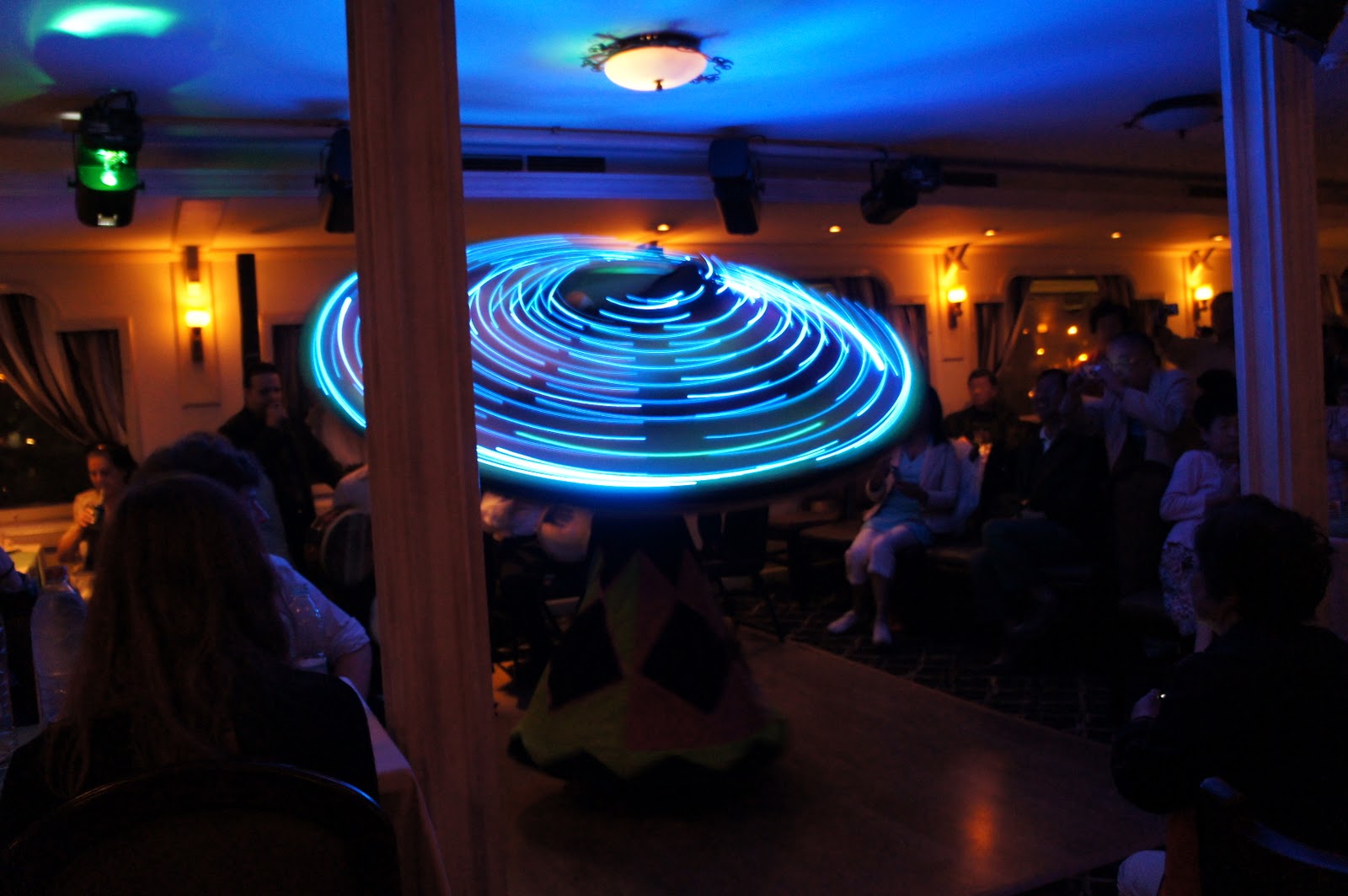 |
| The what I think was tantric dancing during the Nile River Cruise |
Some interesting things I’ve heard/noticed about Egypt:
According to Professor Ghaly, 80 Million people live in Egypt. 95% of the population lives in the Nile River Valley. Additionally, he says that the population increases by a million every eight months.
Gasoline is ~$1.50/gallon in Egypt (1.7 Egyptian pounds/liter), however, as we drove from the airport to the hotel, I saw plenty of Shell and OiLibia Stations but none of the signs displayed the prices. It turns out that the government subsidizes the prices—so all stations have the same priced fuel.
There are few traffic lights in the city of Cairo. No roundabouts either. Instead they converted the 2-way streets to 1-way streets. Drivers seem to disregard the marked lanes (if any) as I have seen up to 3 cars in the width of one lane. Basically, it is utter chaos.
 Melanie and I lit Chanukah candles with prayers and everything (gelt!). Probably we are two of the few people in Egypt to do that tonight. I guess a “Miracle Happened Sort Close to Here”?
Tomorrow I head to the Giza Pyramids and hopefully will ride a camel! I’ll write it here for all ya to read! Any questions? Feel free to ask and I’ll get back to you! Enjoy!
Subscribe to:
Posts (Atom)